

Best Acoustic Panels for Listening Room (Audiophile Guide 2026)
If you’ve invested in high-end amplification, premium DACs, and reference loudspeakers but your system still feels… underwhelming — the problem is probably not your gear.
It’s your room.
For serious audiophiles, hi-fi room acoustics often matter more than upgrading from one amplifier to another. The difference between a good system and a breathtaking system is rarely hardware alone. It’s how sound behaves in your listening environment.
This guide covers:
- The best acoustic panels for listening room setups
- How to treat a dedicated 2-channel space
- Diffusers vs absorbers for hi-fi
- Premium wooden aesthetics for modern interiors
- Where to find acoustic panels USA and buy acoustic panels UAE
- Why Timber Acoustics is launching globally for the audiophile market
Let’s begin where most systems fail: the room itself.
Why Room Acoustics Matter More Than Speakers
Speakers don’t just send sound to your ears. They energize the entire room.
Every surface:
- Reflects
- Absorbs
- Diffuses
- Amplifies certain frequencies
In untreated rooms, you get:
- Bass peaks and nulls
- Blurred imaging
- Smearing of transients
- Collapsed soundstage depth
- Listening fatigue
You could upgrade from a $5,000 speaker to a $20,000 speaker — and still hear minimal improvement if your room has 3-second reverberation and uncontrolled reflections.
Audiophile acoustic treatment is not optional. It is foundational.
In fact, properly treated rooms often make modest speakers outperform far more expensive systems placed in untreated spaces.
How to Treat a 2-Channel Listening Room
Unlike home studios, hi-fi rooms are about realism, depth, and immersion — not just flat frequency response.
Treatment strategy should preserve musicality while controlling reflections.
Step 1: Speaker Placement Basics
Before installing panels, fix geometry.
The Listening Triangle
- Form an equilateral triangle between speakers and listening position
- Maintain symmetry between side walls
- Keep speakers 2–4 feet away from front wall (depending on design)
- Avoid sitting exactly in the center of room length
Toe-in adjustment should focus the soundstage without collapsing width.
Poor placement cannot be corrected by panels.
Step 2: Control First Reflection Points
Side wall reflections blur stereo imaging.
Use the mirror method:
Sit at listening position.
Slide a mirror along the wall.
Where you see the speaker — that’s your reflection point.
Install broadband absorbers there.


For premium hi-fi rooms, fabric-wrapped mineral core panels in wooden frames offer both performance and aesthetic integration.
Step 3: Bass Control (Corners Are Critical)
Low frequencies dominate room interaction.
Without corner treatment:
- Bass becomes uneven
- Kick drums lose definition
- Double bass feels bloated
- Room modes distort tonality
Install bass traps in:
- Front vertical corners
- Rear vertical corners
- Wall-ceiling junctions if possible
High-density broadband corner systems are essential for balanced hi-fi response.
Step 4: Diffusers on Rear Wall
Unlike mixing rooms, listening rooms benefit heavily from diffusion.
Absorption everywhere makes the room dead.
Diffusion maintains energy while breaking up harsh reflections.


Diffusers vs Absorbers (For Audiophiles)
| Absorbers | Diffusers |
|---|---|
| Reduce energy | Scatter energy |
| Tighten imaging | Expand soundstage |
| Control reflections | Maintain spaciousness |
| Improve clarity | Add depth |
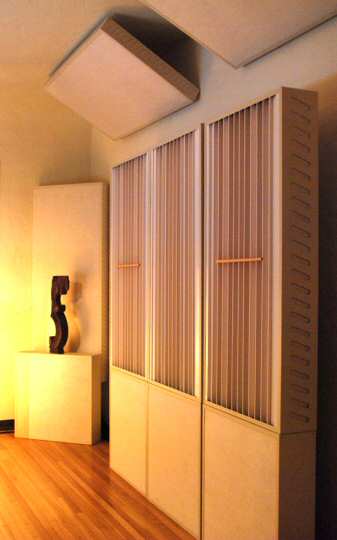
For wooden diffusers for hi-fi, skyline and quadratic designs provide both acoustic and visual impact.
Premium Wooden Aesthetics Matter
Audiophile spaces are not recording studios.
They are curated listening environments.
Wood integrates beautifully with:
- Turntables
- Tube amplifiers
- Premium furniture
- Warm lighting schemes
High-end systems deserve panels that complement design — not industrial foam tiles.
Timber-framed absorbers and handcrafted wooden diffusers elevate the entire room.
Acoustics should feel architectural — not temporary.
Treating Different Listening Room Sizes
Small Room (Under 150 sqft)
- 4 side wall panels
- 2–4 bass traps
- 2 rear diffusers
- 1 ceiling cloud
Medium Room (150–300 sqft)
- 6–8 wall panels
- 4–6 bass traps
- Full rear diffusion
- Ceiling cloud
Large Dedicated Hi-Fi Room
- Zoned absorption
- Full bass trapping system
- Diffusion grid on rear and upper walls
- Hybrid ceiling treatment
Every room requires adjustment based on ceiling height and speaker design.
Before & After (What Changes Sonically)
Before acoustic treatment:
- Bass feels powerful but undefined
- Imaging shifts with head movement
- Reverb tails blur
- Vocal center image drifts
- You increase volume to “feel detail”
After proper audiophile acoustic treatment:
- Bass tightens dramatically
- Soundstage becomes holographic
- Micro-details emerge
- You listen longer without fatigue
- Music feels effortless
That last part is important.
Effortless listening is a hallmark of good acoustics.
Acoustic Panels USA & Buy Acoustic Panels UAE
As high-end audio markets grow globally, demand for premium treatment has expanded beyond local installations.
Search trends show increasing demand for:
- Acoustic panels USA
- Buy acoustic panels UAE
- Premium hi-fi treatment solutions
- Designer acoustic interiors
Discerning audiophiles want:
- Fire-rated compliance
- Export-quality finish
- Custom wood veneers
- CNC precision diffusers
- International shipping reliability
Why Timber Acoustics Is Launching Globally
Timber Acoustics was built at the intersection of wood craftsmanship and sound engineering.
With strong roots in acoustic manufacturing and high-end studio solutions, the brand is expanding internationally to serve:
- Audiophiles in the USA
- Hi-fi markets in the UAE
- Luxury residential projects
- Dedicated listening spaces worldwide
Global expansion includes:
- Distribution partnerships
- Hi-fi expo participation
- Direct-to-consumer international shipping
- Custom design consultations
The focus is clear:
Premium materials.
Architectural finish.
Acoustic precision.
Designed not just for studios — but for serious music lovers.
What Makes the Best Acoustic Panels for Listening Rooms?
Look for:
- High NRC broadband absorption
- Thick core material (50–100mm+)
- Solid wood framing
- Precision diffusion depth patterns
- Balanced absorption-diffusion ratio
- Aesthetic integration with room design
Avoid:
- Thin foam tiles
- Over-absorption
- Random placement
- Treating only one surface
A listening room is an ecosystem.
Balance is everything.